
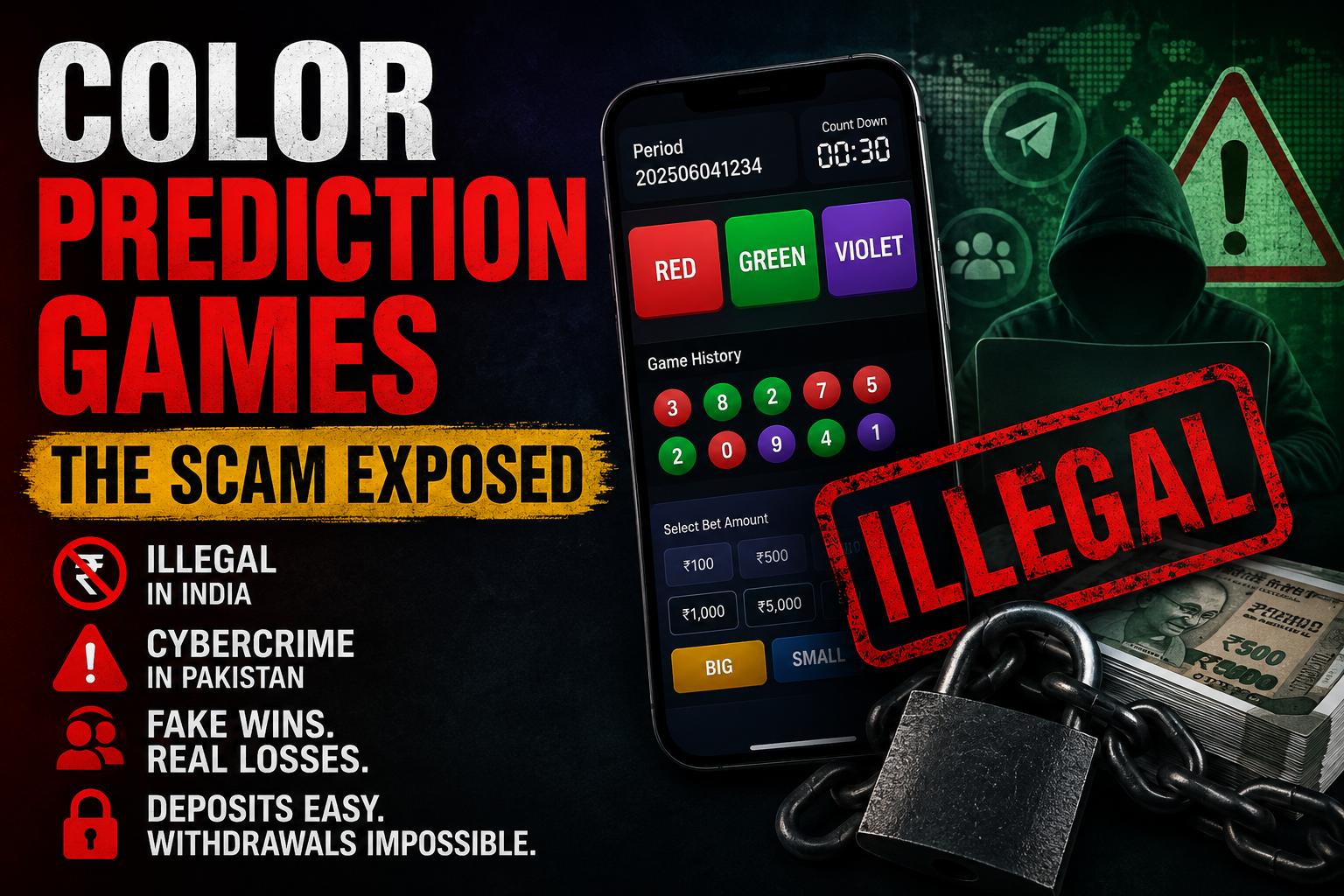
Learn (1) what a color prediction game actually is and why it’s pure chance rather than skill, (2) why these games are explicitly illegal in India and treated as a cybercrime issue in Pakistan, (3) the exact recruitment-to-scam pattern these platforms follow, and (4) what steps to take if you or someone you know has already lost money to one.
Table of Contents
What Is a Color Prediction Game
A color prediction game (sometimes called “color trading”) asks you to place a small bet on which color — usually red, green, or violet — will come up next in a round that lasts anywhere from 30 seconds to a few minutes. Some versions dress this up as “number prediction” or “trading,” letting you bet on a number range instead of a color, but the mechanics are identical.
There is no skill involved. The outcome is decided by a random number generator or, in many documented cases, directly controlled by the platform’s server — meaning the operator can set results to favor the house whenever they choose. Despite this, these apps are marketed with language like “trading,” “investment,” or “prediction accuracy,” which makes them feel more legitimate than a simple bet. They are not investments. There is no underlying asset, no market, and nothing to actually predict.
1. Why Color Prediction Games Are Illegal in India
If you’re playing or promoting these apps for an Indian audience, the legal picture is now explicit rather than a gray area. India’s Promotion and Regulation of Online Gaming Act, 2025 bans all real-money “online money games” nationwide, and color prediction games fall squarely under that definition because they involve paying money in the hope of a chance-based payout. Several states — including Telangana, Andhra Pradesh, Karnataka, and Tamil Nadu — had already taken action against these apps before the national law arrived.
This means any version of a color prediction game where you deposit money to play is illegal across India, regardless of what the app calls itself or how it’s marketed.
2. The Legal Picture in Pakistan and Other Asian Countries
Laws vary by country, and it’s worth being precise rather than assuming India’s rules apply everywhere.
In Pakistan, the main gambling law is the Prevention of Gambling Act, 1977, and in recent years authorities have started treating the hosting of gambling apps or websites as a cybercrime under the Prevention of Electronic Crimes Act (PECA) — carrying steeper penalties than the older law’s approach to physical gambling. In 2025, Pakistan’s National Cyber Crime Investigation Agency (NCCIA) declared dozens of gambling, casino, and unregulated trading apps illegal in a single action, citing both illegal betting and unauthorized collection of users’ personal data.
In other South and Southeast Asian markets, enforcement and legal clarity differ — some countries have specific bans, others rely on older, broader gambling statutes that predate mobile apps entirely. If you’re unsure about your own country, the safest assumption is that a real-money color prediction app is either explicitly illegal or exists in a legal gray area with no consumer protection either way.
3. Red Flag: How Recruitment Actually Works
These platforms very rarely rely on app store listings or search ads to find new users — mainly because they usually can’t get listed on Google Play or the App Store in the first place. Instead, they spread through a fairly consistent pattern:
- An invite arrives through WhatsApp or Telegram, often from someone the recipient already knows — frequently a person who was recruited earlier and is now promoting the app to earn referral commission.
- The message emphasizes fast, easy money with screenshots of supposed winnings, sometimes combined with social media promotion on YouTube or Facebook.
- New users are encouraged to bring in more people, since referral commissions are usually a bigger and more reliable source of “income” on these platforms than the game itself.
A 2025 industry investigation identified roughly 60 websites running variations of this scam, many linked to operators based outside the country they targeted, spreading primarily through Telegram, YouTube, and multi-level referral networks. The referral structure is what allows these apps to spread as fast as they do — it functions less like a game and more like a pyramid scheme with a casino skin on top.
4. Red Flag: Small Early Wins, Then Blocked Withdrawals
The core mechanic that keeps people playing — and losing more — follows a predictable arc:
- Early sessions often result in small wins. This isn’t luck; it’s designed to build confidence and make the game feel legitimate and beatable.
- Confidence leads to bigger deposits. Once a player trusts the app, they’re far more likely to deposit larger amounts, believing they’ve found a working strategy.
- Withdrawals start getting delayed or blocked. Common tactics include telling the user they must deposit more money to “unlock” a withdrawal, or that a “verification fee” is required before funds can be released. Neither of these ever result in the player getting their money back.
- The account may be frozen entirely, with support becoming unresponsive once a user pushes to withdraw a meaningful amount.
None of this is a bug in the system — it’s the business model. The game only needs to feel winnable long enough for a user to deposit more than they’ll ever be allowed to take out.
5. Red Flag: Apps That Get Banned and Relaunch Under a New Name
Even when a specific app is blocked, reported, or shut down, the same operators frequently relaunch under a new name, a new domain, or a new app, using the same referral networks to rebuild their user base quickly. Blocking a single domain or app name is only partly effective, since these platforms can reappear within days and continue reaching users through VPNs or new Telegram channels.
This is one reason judging an app by name alone is unreliable — the underlying operator and scam structure often survives multiple bans under different branding.
6. Why It’s So Hard to Get Your Money Back
Because these platforms are unregulated and often operate across borders, victims have very limited recourse:
- There’s no regulator to complain to. Since the platform isn’t a licensed gambling or financial operator, there’s no consumer protection body responsible for it.
- Money often moves internationally. Investigators in several documented cases have traced funds from these platforms to overseas bank accounts, with money-laundering angles handled by financial crime units rather than local police.
- Reporting a loss can feel legally awkward in countries where real-money gambling itself is illegal, since some victims worry that reporting a scam means admitting to an illegal activity. In practice, cybercrime authorities generally handle these as fraud/scam reports, not gambling prosecutions of small individual users — but this varies by jurisdiction.
This combination — no regulator, cross-border money flow, and hesitance to report — is exactly why these platforms can operate at scale for years.
7. What to Do If You’ve Already Lost Money
If you or someone you know has lost money to a color prediction app, here’s the practical path:
- Stop depositing immediately. Any request for “one more deposit” to unlock a withdrawal is not a real requirement — it’s a tactic to extract more money.
- Document everything. Screenshot the app, your deposit/withdrawal history, chat messages, and any referral links involved before the app disappears or blocks your access.
- Report to your national cybercrime authority. In India, this is the National Cybercrime Reporting Portal (cybercrime.gov.in) or a call to 1930. In Pakistan, reports can be filed with the NCCIA/FIA cybercrime wing. Reporting won’t undo a financial loss, but it helps authorities track and shut down operators, and in some cases assets have been frozen before operators could withdraw funds.
- Contact your bank or e-wallet provider if the deposit was made via card, bank transfer, or a service like JazzCash, EasyPaisa, or UPI — some transactions can be flagged or disputed, particularly if reported quickly.
- Warn the person who referred you, and anyone you referred. Since these platforms spread through personal networks, a direct warning is often more effective than a public post at stopping the chain.
Frequently Asked Questions
Are all color prediction games scams, or are some legitimate?
Functionally, real-money color prediction games are chance-based betting regardless of how they’re marketed. Even where a specific app hasn’t been formally investigated, the mechanics — random or server-controlled outcomes, no regulation, no transparency — are identical across the category. Treat any real-money version as high-risk by default.
Is it illegal for me to just play, or only to run the platform?
This varies by country and isn’t something we can answer generally — enforcement in most places has focused on operators and large-scale promoters rather than individual small players, but the legal risk technically can apply to participation too depending on local law. If you’re unsure, treat it as a real legal question for your specific country, not just a financial one.
Why do these apps keep coming back after being banned?
Because the cost of relaunching under a new name and domain is low, and the referral networks that built the original user base are usually still intact. A ban on one app name rarely dismantles the operator or their network.
Can I trust an app just because it looks professional or has good reviews?
No. Polished design and fake or paid reviews are part of how these platforms build initial trust. A professional-looking interface says nothing about whether the platform will let you withdraw your money.
Color prediction games are built around a simple trade: a game that feels winnable in exchange for deposits that are rarely fully recoverable. The referral system, the early small wins, and the eventual withdrawal problems aren’t separate issues — they’re one designed sequence. If you’re going to engage with any real-money prediction or “trading” app at all, understanding this pattern before you deposit anything is the only real protection available, since no regulator is going to step in for you afterward.
This article is for informational purposes only and does not constitute legal or financial advice. Gambling laws vary by country and change over time — always verify current regulations for your specific location before participating in any real-money game.